
Four Tarot Cards, One Very Human Question
I wasn’t looking for the meaning of life.
I was just curious what four little pieces of cardboard might have to say about mine.
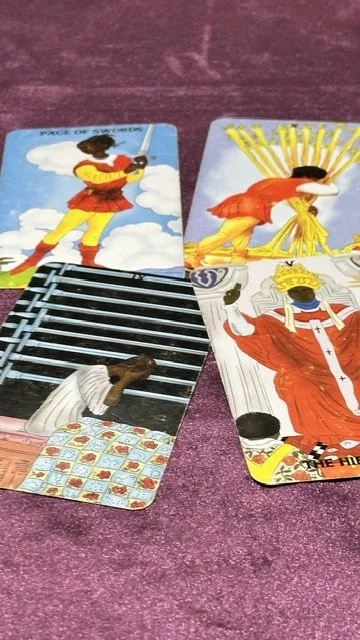
The Cards from left to right are: Page of Swords, the Ten of Wands, a person sitting up in bed with nine swords hanging on the wall, and the Hierophant.
So I sat down with a tarot card reader, shuffled the deck, and pulled four cards.
And that’s when things got uncomfortable.
Not bad uncomfortable.
More like the uncomfortable feeling you get when someone you’ve never met somehow says something about you that you’d rather not admit.
The first card was the Page of Swords.
A young man holding a sword, looking outward, alert and curious.
I looked at him and thought, Okay. I recognize that guy.
He’s the part of us that still wonders what’s next.
It doesn’t matter whether you’re twenty-five and wondering what you’re going to do with your life, forty-five and wondering whether you’ve made the right choices, or sixty-five and wondering what the next twenty years might look like.
There is always a version of ourselves standing at the edge of something, looking forward.
We don’t really outgrow that person.
We just get better at hiding him.
Then I Pulled the Ten of Wands
This card made me laugh.
Not because it was funny.
Because it was painfully obvious.
There’s a man carrying an absurdly large bundle of sticks.
He’s bent forward under the weight, and the bundle is so big that he can barely see where he’s going.
I thought:
Well, apparently the tarot reader has been reading my mail.
But isn’t that all of us at some point?
We carry jobs.
Bills.
Families.
Mortgages.
Relationships.
Expectations.
Parents.
Children.
Regrets.
Plans.
Other people’s opinions.
And then, just for good measure, we carry things that happened twenty years ago as though they happened yesterday.
We tell ourselves we’re being responsible.
Sometimes we are.
But sometimes we’re just carrying things because we’ve forgotten how to put them down.
Then Came the Nine of Swords
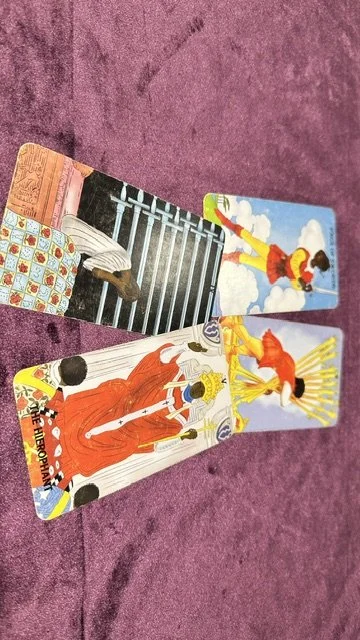
Four tarot cards representing reflection, worry, responsibility and wisdom during a new chapter in life.
This one was less amusing.
A person is sitting up in bed, overwhelmed by what appears to be a terrible night.
The Nine of Swords is traditionally associated with worry, fear, regret and those thoughts that become much louder after midnight.
You know the ones.
Did I say the wrong thing?
What if I had done it differently?
What if something goes wrong?
What if I lose everything?
What if I’m making a terrible mistake?
The funny thing about worry is that it doesn’t require evidence.
Give it five minutes and it can construct an entire disaster movie.
And most of us have watched the movie more than once.
Sometimes we even buy popcorn.
And Then There Was the Hierophant
The fourth card was the Hierophant.
Traditionally, he’s associated with wisdom, teaching, tradition and knowledge passed from one person to another.
And suddenly I saw something in the four cards that had nothing to do with predicting my future.
Maybe they were asking a much more interesting question:
What have I learned?
Not what will happen.
Not when will it happen.
Not whether everything will work out exactly as planned.
But:
What have I learned from everything that has already happened?
That’s a question that belongs to every age.
A twenty-year-old can ask it.
So can an eighty-year-old.
Because age doesn’t automatically make us wise.
Experience doesn’t automatically make us wise.
Sometimes we simply get older and become better at repeating the same mistakes.
Wisdom, perhaps, is recognizing the pattern.
And then choosing differently.
The Things We Thought Would Matter Forever
One of the strange privileges of getting older is discovering that some things you once thought were enormous eventually become footnotes.
The person you couldn’t stop thinking about?
You eventually stopped thinking about them.
The job you thought you couldn’t live without?
You lived without it.
The mistake you were certain would define you?
It didn’t.
The thing you were terrified of?
You survived it.
And then there are the things you didn’t appreciate enough while they were happening.
A dinner around a crowded table.
A dog sleeping at your feet.
A phone call from someone you loved.
A house full of noise.
A quiet morning.
A friend who stayed.
A person who believed in you when you weren’t particularly good at believing in yourself.
Funny how life works.
We spend so much time worrying about what we’re going to lose that we sometimes forget to notice what we have.
Which Brings Me Back to the Cards
Four tarot cards representing reflection, worry, responsibility and wisdom during a new chapter in life.
Four cards.
One person looking ahead.
One person carrying too much.
One person awake with too many thoughts.
And finally, a figure representing wisdom.
Maybe that’s the entire human experience in four pictures.
We look ahead.
We pick things up.
We worry.
We learn.
Then we do it again.
At least, that’s what I’ve been thinking about.
Because I’m beginning to suspect that the goal isn’t to reach some magical point where everything is figured out.
There probably isn’t one.
Maybe the goal is simply to become a little better at knowing what deserves our attention.
What deserves our energy.
What deserves our forgiveness.
And what can finally be put down.
Then There Was the Snake
Around the same time, I had a dream.
And this is where things get a little strange.
I normally hate snakes.
Yet in the dream, there was a beautiful white snake moving around a bird—or perhaps a rooster.
I wasn’t frightened.
I was watching.
The snake never caught the bird.
The bird never seemed desperate to escape.
They moved around each other so gracefully that the whole thing looked almost like a ballet.
And when I woke up, I wasn’t afraid.
I felt wonder.
That word has stayed with me.
Wonder.
Maybe because fear and wonder are surprisingly close cousins.
Both ask us to pay attention.
But fear says:
“Something bad might happen.”
Wonder says:
“Look at that.”
Perhaps as we get older, one of the things we can learn is which voice deserves more of our attention.
What Are You Carrying?
That’s the question I’ve been left with.
Not because I think four tarot cards know my future.
They don’t.
And I don’t think anyone can honestly tell us exactly what is waiting around the corner.
But they can sometimes give us a useful mirror.
And maybe that’s what happened to me.
I saw the young person still looking ahead.
I saw the weight I’ve carried.
I saw the nights when my own thoughts became heavier than reality.
And I saw the possibility of becoming the person who knows the difference between something worth carrying and something that should finally be put down.
Maybe you’re carrying something, too.
Maybe it’s a relationship.
A grudge.
A career that no longer fits.
A dream you outgrew.
A dream you haven’t given up on.
A mistake.
A fear.
Or maybe you’re carrying something wonderful that you’re simply afraid to lose.
Whatever it is, perhaps the question isn’t whether we can carry it.
Most of us can.
The better question might be:
Do we still want to?
I don’t know what the future holds.
And, surprisingly, I’m becoming okay with that.
Because maybe not knowing is part of the adventure.
Maybe the next chapter doesn’t need to be perfectly planned.
Maybe we just need to pay attention.
Put down what has become too heavy.
Keep what still matters.
And leave a little room for wonder.
After all, none of us really knows what’s coming next.
And perhaps that’s the most interesting part.
This is a personal reflection from the Casa Alon Journal—not a prediction, and not a prescription. Just one person’s attempt to make sense of four cards, one strange dream, and the wonderfully unfinished business of being human.
